Prescription & Pharmacy Prices in Thailand 2026: What Medications Actually Cost
A standard prescription drug in Thailand costs a fraction of the US or UK price, but where you buy it matters almost as much as what you buy. Hospital pharmacies routinely charge 64% to 155% more than the standalone pharmacy across the street for the identical box, and outlier items can run 6x higher. A basic antihistamine that costs ฿23.5 (~$0.70) at an independent pharmacy has been billed at ฿60 (~$1.80) at Bumrungrad's in-house dispensary for the same tablet. The fix is simple: ask the doctor for a written prescription and fill it wherever you like.
All prices below are in Thai baht with US dollars converted at the site anchor of ฿33/USD (rates move; this is a July 2026 snapshot).
Quick answer: what to expect
- Basic OTC painkillers (paracetamol, ibuprofen): ฿20–40 (~$0.60–1.20) a box, some of the cheapest in the world
- Common antibiotics (amoxicillin, azithromycin): available over the counter at most Thai pharmacies without a prescription, priced per tablet at a few baht to a few dozen baht
- Hospital pharmacy markup: 64–155% above standalone pharmacy prices for identical products, confirmed by itemized Bumrungrad receipts
- Generic vs. brand: once a patent expires, a Thai-made generic with the same active ingredient is routinely half the price or less of the imported brand
- GLP-1 weight-loss drugs (Ozempic, Wegovy, Mounjaro): ฿7,500–34,000/month depending on drug and dose — a fast-growing, expensive category
- Monthly chronic-condition drug bill: commonly ฿300–3,000 depending on condition and whether you buy generic or brand
Pharmacy vs. hospital: the markup that catches people out
Thai hospitals — private ones especially — run their own in-house pharmacy as a revenue line, not a convenience. Because hospital pricing in Thailand is largely indicative rather than published since transparency eroded after 2023, most patients never see the standalone-pharmacy price to compare against, so they simply pay whatever the hospital dispensary quotes.
An itemized comparison of Bumrungrad's in-house pharmacy against a nearby independent pharmacy (Southeast Asia Pharmacy) found:
| Item | Hospital pharmacy | Independent pharmacy | Markup |
|---|---|---|---|
| Aerius (antihistamine tablet) | ฿60 | ฿23.5 | 155% |
| Elomet (corticosteroid ointment, per tube) | ฿123 | ฿75–80 | 64% |
| Tegaderm-Film plaster | ฿150 | ฿20 | 650% |
Source: Thaiwebsites.com itemized Bumrungrad pharmacy receipt comparison · verified July 2026 · ฿33/USD. Single anecdotal comparison, not an exhaustive survey — treat as illustrative of the pattern, not a universal multiplier.
The pattern holds directionally across most private hospitals, even though the exact percentage varies item by item. A single dressing or a week of antihistamines is not going to break anyone's budget at either price. The problem is chronic prescriptions — a drug you take every month for years — where a 60–150% markup compounds into real money. If a doctor writes you a prescription for something you will be taking long-term, ask explicitly whether you can fill it outside, and most Thai doctors will hand over a written script without objection.
What common medications actually cost
Thailand ranks among the cheapest countries in the world for pharmaceuticals — one global drug-price survey put Thai prices roughly 93% below the median across a 50-country basket. That headline number is a comparison of relative pricing indices rather than a menu, so here is what it translates to for medications expats actually ask about.
| Medication category | Typical Thailand price | Notes |
|---|---|---|
| Paracetamol / Panadol / Sara (box) | ฿20–40 (~$0.60–1.20) | Thai generic brands (Sara, Akamol) cheaper than imported Panadol |
| Ibuprofen (box) | ฿30–60 (~$0.90–1.80) | Widely available OTC |
| Amoxicillin / azithromycin (course) | ฿50–300 (~$1.50–9) | Sold OTC at most pharmacies without a script, unlike in the US/UK/Australia |
| Blood pressure meds (e.g. lisinopril-class) | Roughly 50–60% below global median | Generic Thai equivalents cost less again |
| Cholesterol meds (statins) | Roughly at or slightly below global median | Brand vs. generic gap is the bigger lever than country |
| Asthma inhalers (salbutamol) | Roughly 45% below global median | Generic inhalers widely stocked |
| GLP-1 weight-loss (Ozempic, Wegovy) | ฿7,500–19,000/month | Price scales with dose; below ~฿10,000/month flagged as a counterfeit-risk zone |
| GLP-1 (Mounjaro) | ฿13,990–33,990/month | Premium tier of the same drug class |
Source: Pacific Prime global drug-price index comparison (16 May 2025); TRT Bangkok GLP-1 cost survey (verified April 2026); ExpatDen pharmacy guide 2026 · verified July 2026 · ฿33/USD. Percentage comparisons are index-based, not fixed baht figures — treat ranges as directional and confirm at point of purchase.
The GLP-1 category deserves its own caution: Bangkok customs reported seizing over 119,000 counterfeit GLP-1 injectable units in 2025, and legitimate clinics warn that anything priced well under ฿10,000 a month is a red flag for a fake pen. Buy these only through a licensed clinic or hospital with a cold-chain-verified product, not a discount seller.
Generic vs. brand name: where the real savings are
The single biggest lever on your pharmacy bill is not which pharmacy you use, it is whether you accept the generic. Once a drug's patent expires, Thailand's Government Pharmaceutical Organisation (GPO) and several domestic manufacturers produce the identical active ingredient under a Thai brand name, typically at a fraction of the imported originator's price. GPO branches are identifiable by their aquamarine-blue signage, and pharmacists will substitute a generic for an imported brand on request unless you specifically ask for the original.
For a long-term chronic condition (blood pressure, cholesterol, thyroid), switching from the imported brand to the Thai generic equivalent commonly cuts the monthly cost by half or more, with the same active compound at the same dose. Ask your pharmacist directly: "Same active ingredient, cheaper brand?" — it is a completely normal question in Thailand and nobody will look at you strangely for asking.
Where to buy: chains vs. independents
Thailand has three tiers of pharmacy, and each suits a different need.
- Chain pharmacies (Boots, Watsons, Drug Square): consistent stock, English-speaking staff in tourist areas, predictable pricing, but 10% or more above independents on comparable items. Watsons tends to run cheaper than Boots on the same SKUs, especially during promotions.
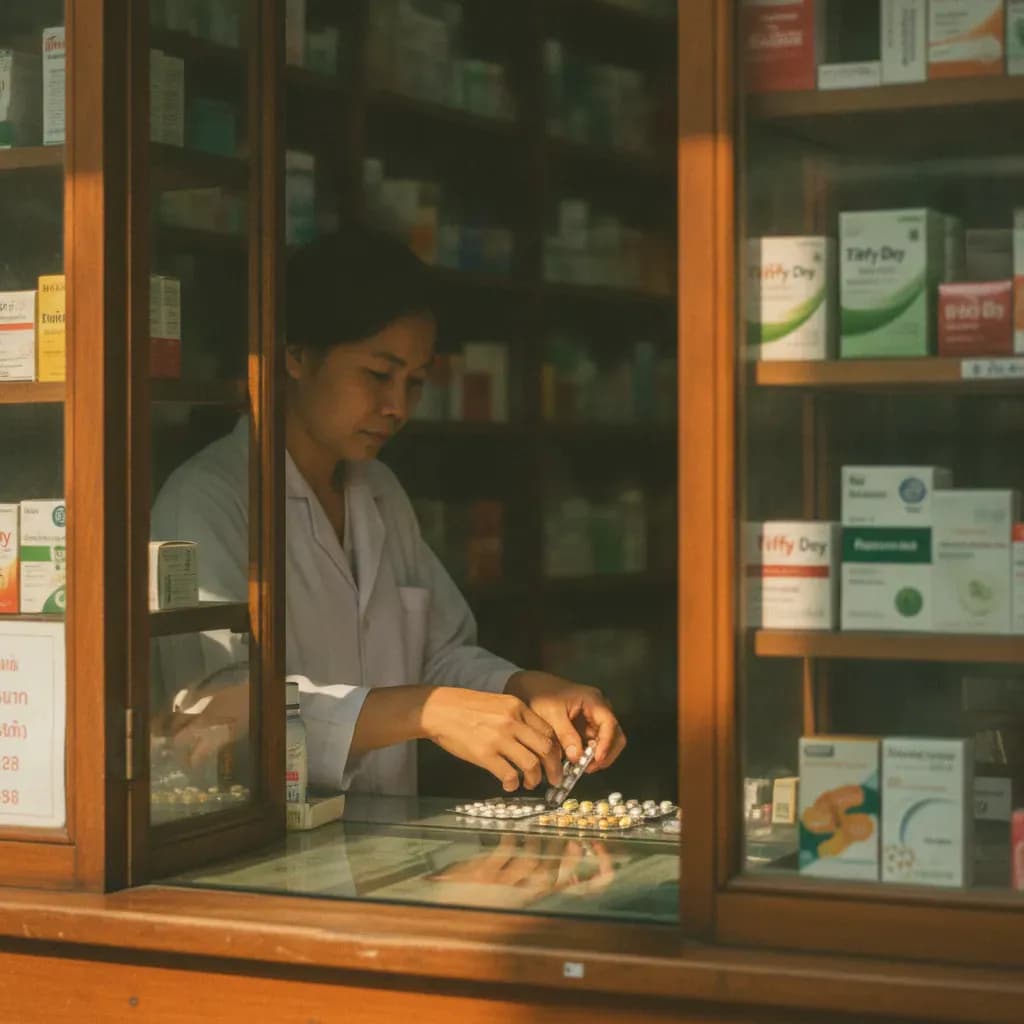
- Independent street pharmacies: the best prices for common generics and OTC basics, staffed by a licensed pharmacist who can dispense many prescription-only-in-the-West drugs (antibiotics, some steroid creams) without a doctor's note. Quality and English ability vary by location.
- Hospital pharmacies: convenient if you are already there for a consultation, but carry the steepest markup as shown above. Fine for a one-off course; avoid for anything recurring.
If you are on a maintenance drug for a chronic condition and carry expat health insurance, check whether your policy actually reimburses outpatient prescriptions — many plans cover inpatient care generously but treat pharmacy purchases as an out-of-pocket outpatient expense, so understanding how claims work at Thai hospitals before you need it saves an argument later.
The bigger healthcare-cost picture
Pharmacy spending is usually the smallest line in a Thailand healthcare budget, dwarfed by hospital admissions, diagnostics and ER visits without insurance, which can run ฿80,000–300,000+ for a single moderate emergency. If you are budgeting your full annual healthcare exposure rather than just the pharmacy line, the Thailand cost-of-living calculator folds a realistic insurance and out-of-pocket allowance into a full monthly budget, and retirees specifically should look at how healthcare costs rise with age before assuming today's drug bill is next decade's drug bill.
Frequently Asked Questions
Can I buy prescription drugs over the counter in Thailand without a prescription?
Yes, for many categories. Thai pharmacy law lets a licensed pharmacist dispense drugs that require a doctor's prescription in the US, UK or Australia, including common antibiotics like amoxicillin, azithromycin, ciprofloxacin, metronidazole and doxycycline. Controlled substances, strong painkillers and some psychiatric medications still require a prescription and are tightly regulated.
Is it cheaper to buy medication at a hospital or an independent pharmacy in Thailand?
Independent pharmacies are almost always cheaper. Itemized comparisons at Bumrungrad found hospital pharmacy prices running 64% to 155% above the same products at a nearby independent pharmacy, with one plaster item marked up 650%. Ask for a written prescription and fill it outside if the drug is for ongoing use.
How much does a month of common chronic medication cost in Thailand?
It depends heavily on brand vs. generic, but a typical month of a single generic maintenance drug (blood pressure, cholesterol) commonly runs ฿300–1,500 ($9–45), while the imported brand-name version of the same drug can run two to three times that. Multiple conditions and brand-name choices push a monthly pharmacy bill toward ฿3,000–5,000 ($90–150) or more.
Are generic medicines in Thailand as good as the branded originals?
For medications past patent expiry, Thai-made generics use the same active ingredient at the same dose and are manufactured under Thai FDA oversight, including a large share produced by the state-run Government Pharmaceutical Organisation (GPO). Quality is generally considered equivalent; the price difference reflects branding and import costs, not efficacy, though individuals occasionally report different tolerance to a specific manufacturer's formulation.
What should I watch out for with GLP-1 weight-loss drugs like Ozempic or Wegovy in Thailand?
Price and counterfeits. Legitimate Ozempic and Wegovy in Thailand run roughly ฿7,500–19,000 a month depending on dose, and Mounjaro roughly ฿13,990–34,000. Bangkok customs seized more than 119,000 counterfeit GLP-1 injectable units in 2025, and clinics warn that any offer priced well under ฿10,000 a month is a strong signal of a fake product. Buy only through a licensed clinic or hospital pharmacy with verified cold-chain handling for this specific category, even though it costs more than a street pharmacy would.
The bottom line
Thailand's pharmacy prices are genuinely cheap by global standards, but the savings are not evenly distributed. Basic OTC drugs and most generics cost a few dollars; hospital pharmacies charge a real premium for the identical box; and newer drug categories like GLP-1 injectables carry both a high price and a counterfeit risk that basic paracetamol never will. The single highest-leverage habit is asking for a written prescription and filling anything long-term outside the hospital gate.
Sources
- Thaiwebsites.com, Bumrungrad Medical Expenses and Drug Prices, accessed 2026-07-10
- Pacific Prime, Thailand Prescription Medication Costs Without Insurance, 16 May 2025
- TRT Bangkok, GLP-1 Cost Thailand 2026 comparison, verified April 2026
- ExpatDen, How to Buy Over-the-Counter Pills in Thailand 2026
- VERIFIED-FACTS-2026-07.md internal dossier, healthcare and FX sections