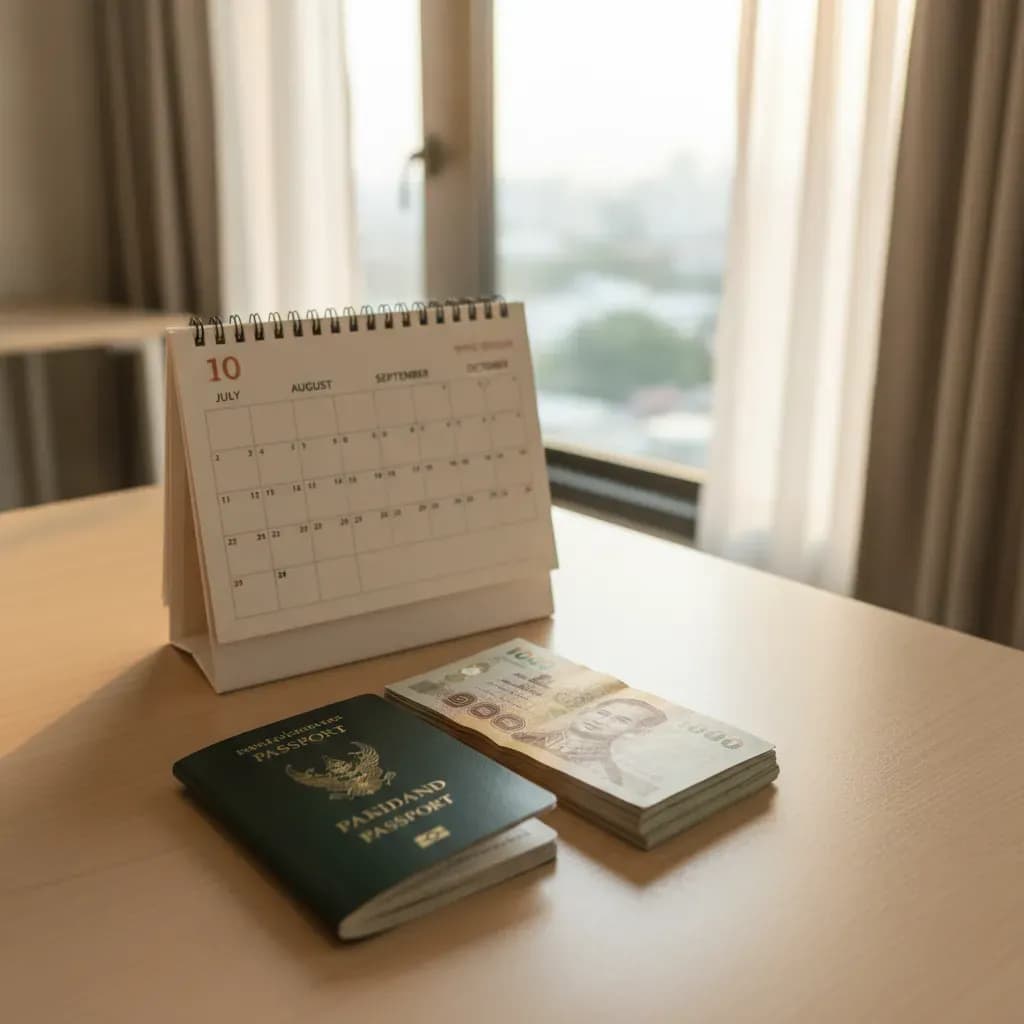
DTV Financial Requirements 2026: The 500k THB Rule & 90-Day Seasoning
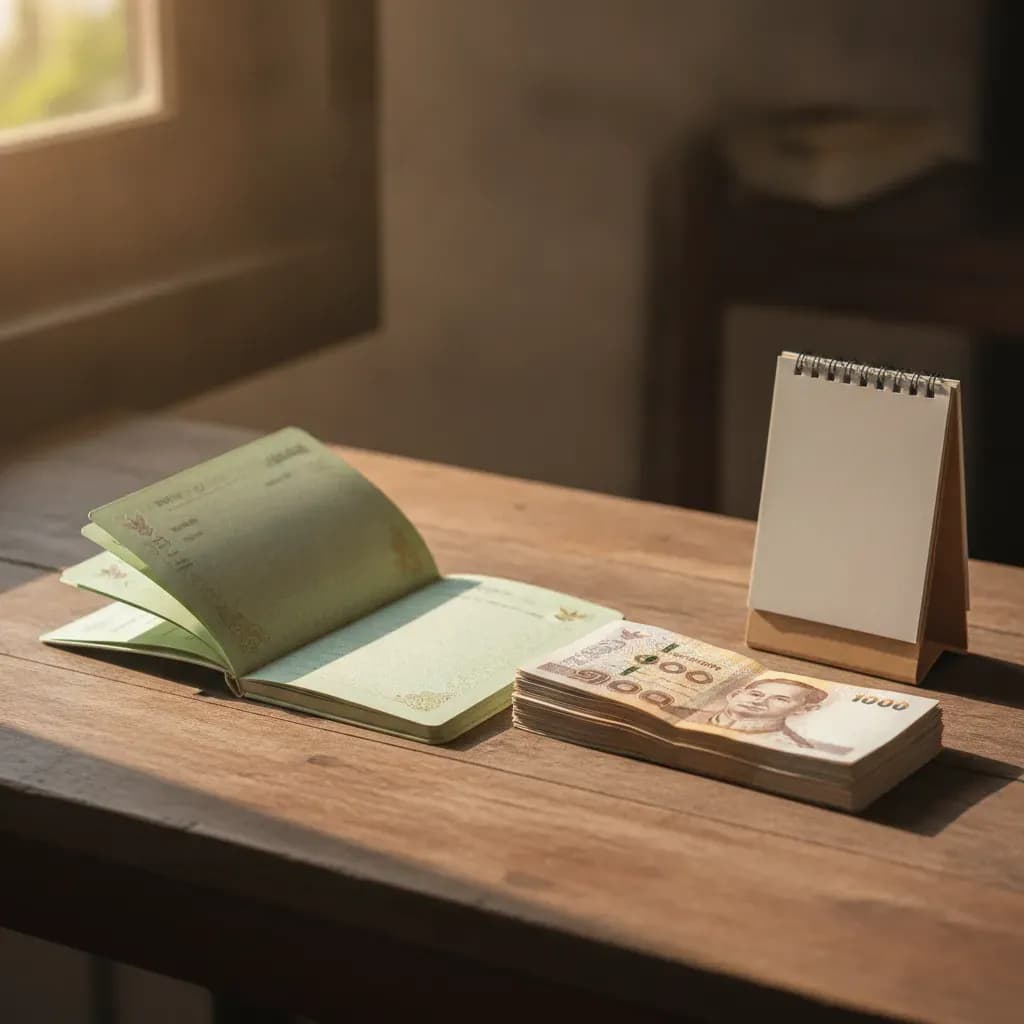
To qualify for Thailand's Destination Thailand Visa (DTV) in 2026, you need at least ฿500,000 (~$15,000-15,150 at ฿33/USD) sitting in liquid personal funds, and that balance has to have stayed above the line for roughly 90 days before you apply, verified at every month-end, not just on the day you screenshot your statement. The single biggest reason applications get refused is depositing the full amount right before applying — officers call it "fund parking," and it is easy to spot in a bank statement.
This page covers the money side only: the exact number, how the seasoning window actually works, which embassies check harder, and what counts as acceptable proof. The application steps, visa categories (remote work vs. soft power), and document submission process live on our sister visa-process site — this is the money layer.
Quick answer
- Minimum balance: ฿500,000 (~$15,000-15,150), or the equivalent in USD, GBP, EUR or another major currency at the prevailing rate on your statement date
- Seasoning window: approximately 90 days (3 months) with the balance staying above ฿500,000 at every month-end, not just on application day
- #1 rejection cause: lump-sum deposits shortly before applying — a balance that jumps from ฿50,000 to ฿500,000 two weeks before submission reads as parked money
- Embassy variance is real: London and Taipei often want 6 months of statements plus a bank manager's letter; Jakarta and Vientiane have sometimes accepted a 30-day balance when the rest of the file is strong
- Brokerage, crypto and mutual fund balances are not accepted as primary proof of funds at any embassy on record
- DTV holders are refused new Thai bank accounts almost universally in 2026 — plan to prove funds from an existing account back home
Run your own numbers against the threshold with the DTV funds checker before you start moving money around.
Not sure your bank statement passes? Run it through the checker.
Check my fundsThe ฿500,000 rule, in plain terms
The DTV, launched in 2024 for remote workers, freelancers and "soft power" activity participants (Muay Thai, cooking courses, medical tourism and similar), requires at least ฿500,000 in liquid funds as proof you can support yourself in Thailand without working locally. Foreign currency is fine — USD, GBP, EUR and other major currencies are accepted at their equivalent value on the statement date. You do not need the money in a Thai bank; a personal account in your home country works, and for most applicants in 2026 that is the only realistic option (more on that below).
"Liquid" is the operative word. This is a savings or checking account in your own name, not a joint account everywhere (some missions tolerate joint accounts, others do not), and not an investment position. A brokerage statement showing a $20,000 stock portfolio does not satisfy this requirement, no matter how liquid the underlying assets actually are. Neither does a crypto wallet balance or a mutual fund statement. Reviewing officers want a bank balance they can trace month by month, and stocks or coins do not produce that kind of trail.
At the site's standard exchange anchor, here is what ฿500,000 looks like in the currencies most applicants use:
| Currency | Approx. equivalent to ฿500,000 |
|---|---|
| USD | ~$15,150 |
| GBP | ~£11,360 |
| EUR | ~€13,160 |
| AUD | ~A$21,740 |
Source: calculated at the Thailand Ultimate site FX anchor (฿33/USD, ฿44/GBP, ฿38/EUR, ฿23/AUD) · verified July 2026. Spot rates move daily — check your bank's rate on your actual statement date, since embassies value your balance at the rate shown on the document, not a fixed anchor.
The 90-day seasoning window: how it actually works
"Seasoning" means the money has to look like it belongs to you, not like it was borrowed or moved in specifically to pass the visa check. In practice this means your account balance needs to sit above ฿500,000 (or the equivalent) at every month-end for roughly three months before you submit your application — not just meet the threshold on the day you pull the statement.
A concrete example: if you apply in October, an officer wants to see your balance was above the line at the end of July, the end of August, and the end of September, plus the current balance at time of application. A single dip below ฿500,000 at any of those checkpoints — even for one day — can trigger a request for more documentation or an outright refusal, because it breaks the "unbroken" pattern reviewers are trained to look for.
| Month-end checkpoint | What officers want to see |
|---|---|
| 3 months before application | Balance already at or above ฿500,000 |
| 2 months before application | Balance still at or above ฿500,000, no unexplained dip |
| 1 month before application | Balance still at or above ฿500,000 |
| Application date | Current statement, typically dated within 7-30 days of submission depending on embassy |
Source: Siam Legal International DTV guidance; ThaiNomadLife DTV Financial Proof Guide 2026 · verified July 2026.
Most bank statement PDFs show a running daily balance, which makes this easy for an officer to check and easy for you to sabotage by accident. If you pay a large one-off bill, or move money between accounts to consolidate for the application, do it early and let the dust settle for a full month before the window you are submitting.
Fund parking: the #1 rejection reason
"Fund parking" is the term reviewers and visa agents use for a lump sum deposited into an account shortly before applying, specifically to clear the ฿500,000 line. It is the single most commonly cited cause of DTV financial-proof refusals in 2026. The tell is obvious on a statement: a balance sitting at ฿30,000-80,000 for months, then a sudden jump to ฿500,000+ two or three weeks before the application date.
The fix is not clever formatting — it is time. Move the money in, let it season for the full window, and apply once the month-end checkpoints are clean. If you cannot wait, some applicants with strong "soft power" documentation (enrollment letters, course receipts, employment evidence) have had lenient missions accept shorter windows, but this is not something to plan around. Treat 90 days as the real requirement, not a best-case minimum.
Statement format matters too. Most embassies want an official document on bank letterhead, bearing a bank stamp or verifiable digital certification, dated within roughly 7-30 days of your application (the exact window depends on the mission). A screenshot from a banking app is frequently rejected at the stricter posts. If your statement is in a language other than English or Thai, expect to need a certified translation — though London has been reported to accept English-language UK documents without additional notarization, which is the kind of embassy-specific detail worth confirming directly before you submit. Our proof-of-funds format guide and the companion piece on bank statement rules that get applications rejected go deeper on formatting.
Embassy variance: not every mission reviews the same file the same way
DTV applications go through Royal Thai embassies and consulates worldwide, and in practice they do not all apply the same bar. This is the part most guides gloss over and the part that causes the most confusion among applicants comparing notes online.
| Embassy tendency | Missions commonly cited | What that means in practice |
|---|---|---|
| Strict | London, Taipei | Often want up to 6 months of statements, sometimes a signed bank manager's letter, and close scrutiny of any recent deposit |
| Standard | Most other missions | Follow the baseline 3-month seasoning rule with a statement dated within roughly 30 days |
| Lenient | Jakarta, Vientiane | Have sometimes accepted a shorter, roughly 30-day balance history when the rest of the application (soft-power documentation especially) is strong |
Source: Thai Visa Services DTV Complete Guide 2026; StampStay "Will Your DTV Bank Statement Get Rejected?" 2026; ThaiNomadLife 2026 · verified July 2026. Embassy practice is not published policy and can change without notice — confirm current requirements directly with the specific mission before applying.
The practical takeaway: which embassy you apply through matters as much as your bank balance. If you have a choice of where to apply — some applicants can apply from a country where they hold residency rather than only their passport country — a mission known for a lighter touch on seasoning can matter more than an extra ฿100,000 in the account. That said, do not apply from inside Thailand on a tourist stamp; that is a separate and near-automatic rejection trigger unrelated to your finances.
What counts as proof, and what does not
Reviewing officers are looking for a personal bank account balance they can trust and trace. Here is the practical accepted/not-accepted split as reported across 2026 applications:
| Accepted | Not accepted as primary proof |
|---|---|
| Personal savings or checking account statement | Brokerage or investment account statement |
| Foreign currency account (USD, GBP, EUR, etc.) at equivalent value | Cryptocurrency wallet balance |
| Bank statement on official letterhead with stamp/certification | Mutual fund or managed portfolio statement |
| Joint account (accepted at some missions, not all) | Verbal or informal proof of assets |
Source: Siam Legal International; Thai Visa Services DTV Complete Guide 2026 · verified July 2026. Joint account treatment varies by embassy — confirm before relying on one.
If your liquid savings sit mostly in a brokerage account, the move is to transfer the required amount into a plain savings account well ahead of your target application date, so it has time to season properly rather than looking like a rushed conversion.
The bank account trap: DTV and Thai banking don't mix well
One thing that surprises new DTV holders: getting the visa does not make it easy to open a Thai bank account. In 2026, major Thai banks are refusing new accounts to DTV holders almost universally, treating the DTV as a tourist-category visa under stricter anti-fraud know-your-customer rules. Some travelers report occasional exceptions at agent-assisted or tourist-area branches, but this is not something to plan a budget around — treat it as "sometimes possible, never guaranteed." Our guide on opening a Thai bank account on a DTV covers what has and has not worked for others, and the broader best Thai bank for foreigners piece covers the visa categories that do get a warmer reception at the teller window.
Practically, this means most DTV holders keep their qualifying ฿500,000 in a home-country account throughout their stay and manage day-to-day spending through international cards, Wise transfers, or a foreign-currency deposit account rather than a standard Thai savings account.
How the DTV number compares to other visa routes
The ฿500,000 DTV threshold is a mid-tier figure among Thailand's long-stay visa options. It sits below the retirement visa's ฿800,000 deposit rule and well below the LTR visa's asset and investment thresholds, but it is meant to prove liquidity for a shorter, renewable stay rather than long-term settlement. Unlike the retirement visa's minimum-age-50 requirement, DTV has no age floor, which is part of why it has become the default route for remote workers and younger long-stay applicants.
None of these visa categories change your Thai tax exposure on their own — how much foreign income you owe tax on if you remit it depends on residency days and the remittance rules covered in our tax residency tracker, a separate question from the visa's financial-proof requirement.
Frequently Asked Questions
How much money do I need for a DTV visa in 2026?
At least ฿500,000 (roughly $15,000-15,150 at ฿33/USD), or the equivalent in your home currency, held in a personal savings or checking account. The balance needs to have stayed above that line for roughly 90 days before you apply, checked at each month-end, not just on the application date.
Can I just transfer ฿500,000 into my account right before applying?
You can, but it is the leading cause of DTV financial-proof rejections. Officers look for an unbroken balance across roughly three month-end checkpoints before your application date. A sudden lump-sum deposit right before applying — "fund parking" — is easy to spot and commonly flagged.
Does the ฿500,000 have to be in a Thai bank account?
No. Most applicants prove funds from an account in their home country, and this is fortunate because DTV holders are refused new Thai bank accounts almost universally in 2026. Foreign currency accounts are accepted at their equivalent value.
Can I use a brokerage or crypto account to prove DTV funds?
No embassy on record accepts brokerage, mutual fund, or cryptocurrency balances as primary proof of funds. Move the required amount into a plain personal savings or checking account well ahead of your target application date.
Which Thai embassies are strictest about DTV bank statements?
London and Taipei are commonly cited as the strictest, sometimes asking for up to six months of statements and a signed bank manager's letter. Jakarta and Vientiane have been reported as more lenient, occasionally accepting a shorter balance history when the rest of the application is strong. Practice varies and can change without notice, so confirm directly with the mission you plan to use.
Do I need to translate my bank statement for a DTV application?
Often yes, if the statement is not in English or Thai — expect to need a certified translation. Some missions, London among them, have accepted English-language home-country documents without additional notarization. Requirements differ enough by embassy that confirming with the specific mission before you submit is worth the extra step.
The bottom line
The DTV's money test is simple to state and easy to fail anyway: ฿500,000, held clean for about 90 days, checked at every month-end. The applicants who get refused almost never fail because they lack the money — they fail because they moved it in too late and left a visible seam in the bank statement for an officer to find. Season the balance early, pick your embassy with its reputation in mind if you have a choice, and keep the proof in a plain personal bank account rather than a brokerage or crypto wallet. Check your own numbers against the current threshold with the DTV funds checker before you start moving anything.
Sources
- Siam Legal International, DTV Visa Thailand 2026, accessed 2026-07-10
- ThaiEmbassy.com, Destination Thailand Visa (DTV) 2026 Official Guide, accessed 2026-07-10
- ThaiNomadLife, DTV Financial Proof Guide 2026, accessed 2026-07-11
- StampStay, Will Your DTV Bank Statement Get Rejected? 2026, accessed 2026-07-11
- Thai Visa Services, DTV Visa Complete Guide 2026, accessed 2026-07-10