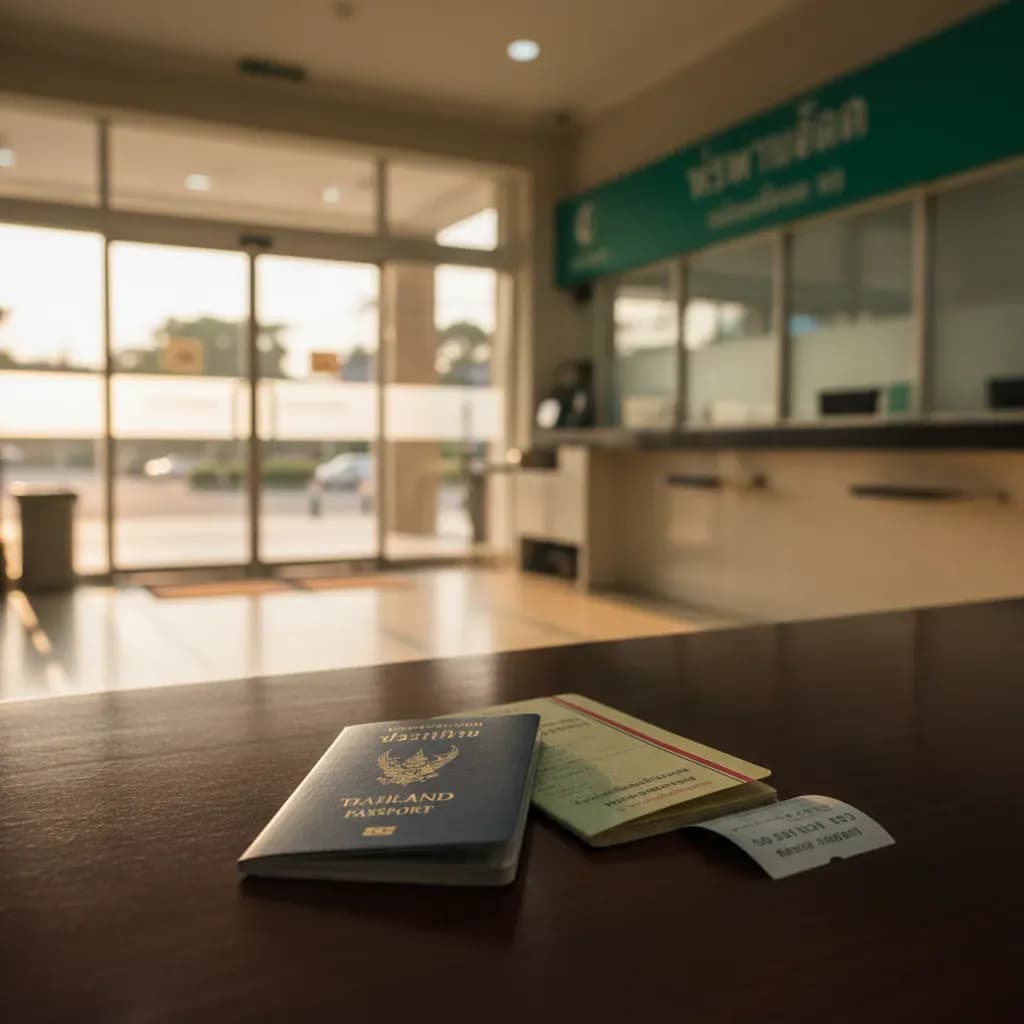
How to Open a Thai Bank Account in 2026: Every Route That Still Works
Your visa, not your nationality or your bank balance, decides whether a Thai bank opens an account for you in 2026. LTR visa holders get the smoothest path — KBank will open an account at any branch nationwide with no appointment, and Bangkok Bank does it too once you email the BOI's LTR unit at least four business days ahead. Retirement extensions, Non-B work permits, Non-O marriage visas and ED student visas all still work at most branches. DTV holders are refused almost everywhere — Bangkok Bank, KBank, SCB, Krungthai and Krungsri have all tightened since January 2026, and tourist-category visas now fail anti-mule KYC checks at the counter.
Quick answer
- LTR visa: the priority credential — KBank any branch, no appointment; Bangkok Bank needs an email to [email protected] ≥4 days before your visit
- Retirement (Non-O/O-A), Non-B + work permit, Non-O (marriage), ED visa: all still open accounts at most banks, with the right documents
- DTV holders: refused near-universally in 2026 at every major bank — plan around it, don't count on it
- Minimum opening deposit: ฿500–2,000 depending on the bank; most require ฿2,000 average balance to skip a monthly fee
- The one document that unlocks everything: a Certificate of Residence from Thai Immigration, or a registered 12-month lease — a short Airbnb booking no longer counts
- Agents and "expat-friendly" branches can smooth the process but are not a guaranteed workaround for tourist or DTV status
Why your visa decides everything in 2026
Thai banks answer to the Bank of Thailand's anti-money-laundering and anti-"nominee" rules, and those rules got noticeably stricter through 2025 and into 2026. Every major bank now treats a long-term, non-immigrant visa as the baseline requirement for a new account, and short-stay or tourist-category permits — including the DTV — are increasingly treated as a red flag rather than a formality. This isn't personal and it isn't negotiable at the counter: a teller who says no usually isn't authorized to explain why, and appealing to a different clerk at the same branch rarely helps.
The practical result is that your visa category puts you on one of three tracks: a fast, well-documented route (LTR, work permit holders), a normal but paperwork-heavy route (retirement, marriage, ED visas), or a route that mostly doesn't work in 2026 (DTV, tourist visas, visa exempt entries). Knowing which track you're on before you walk into a branch saves a wasted afternoon.
Route by route: which visa opens an account
| Visa / status | Works in 2026? | Best bank | Notes |
|---|---|---|---|
| LTR (Long-Term Resident) | Yes — priority route | KBank (any branch) or Bangkok Bank | KBank needs no appointment; BBL needs a BOI email ≥4 days ahead |
| Non-B + work permit | Yes | KBank, Bangkok Bank, SCB | Work permit is the strongest single document you can bring |
| Retirement extension (Non-O/O-A) | Yes | KBank, Bangkok Bank | Certificate of Residence or registered lease usually required |
| Non-O (marriage) | Yes | KBank, Bangkok Bank | Same document rules as retirement extensions |
| ED visa (student) | Yes, usually | KBank | School enrollment letter helps; some branches are stricter |
| DTV (Destination Thailand Visa) | Refused near-universally | None reliable | Classed as tourist-category under 2025+ KYC rules |
| Tourist visa / visa exempt | No | None | Not accepted as a basis for a new account at any major bank in 2026 |
Source: BOI LTR Visa Unit; MBMG Group; The Pattaya News (29 Jan 2026); Thai Visa Services · verified July 2026 · ฿33/USD.
The LTR route: the fastest path in the country
If you hold the LTR visa, banking is the one part of Thai bureaucracy that actually gets easier. KBank (Kasikornbank) will open an account for an LTR holder at any branch nationwide, with no advance appointment needed. Walk in with your passport, LTR visa, and proof of address, and most branches process it same-day.
Bangkok Bank also accepts LTR holders, but it wants advance notice: email the BOI's LTR Visa Unit ([email protected]) at least four business days before your visit, naming the specific branch and your preferred date and time. Send your supporting documents by email in advance and bring the originals to the appointment. This isn't bureaucratic friction for its own sake — BBL uses the lead time to brief the branch so the teller doesn't have to improvise with an unfamiliar visa category. SCB and other banks will generally also open accounts for LTR holders, though KBank remains the fastest and most consistently reported route.
Retirement, work permit, marriage and student visa routes
Outside the LTR fast lane, four visa categories still reliably open Thai bank accounts in 2026, provided you bring the right paperwork:
- Retirement extension (Non-O/O-A): the visa most retirees hold once they've converted their initial entry. Banks want to see the extension stamp and usually a Certificate of Residence or long-term lease. See the retirement visa money requirements for the ฿800,000 deposit and 65,000/month income rules that get you the visa in the first place.
- Non-B with a work permit: a work permit is close to a golden ticket at most branches, because it proves both legal residency and an income source. Non-B alone, without the permit, is treated with more suspicion.
- Non-O (marriage to a Thai national): documentation mirrors the retirement route — marriage certificate, visa extension stamp, and proof of address.
- ED visa (student): works at most branches, especially with a school enrollment letter, though a few branches apply stricter scrutiny to ED-visa applicants than to other long-term categories.
None of these are instant. Expect one branch visit if your documents are complete, or two if the branch needs to escalate an unfamiliar case to a manager — which happens more often outside Bangkok's expat-heavy districts.
The documents every route actually needs
Regardless of visa type, bring the same core folder:
- Original passport, valid at least six months
- Your long-term visa or extension stamp — Non-B, Non-O, ED, LTR, or a retirement extension
- A working Thai mobile number — banks will not open an account without one, since SMS one-time-passwords are now standard
- Proof of address, ranked by reliability: a Certificate of Residence from Thai Immigration is the gold standard; a certified letter of residence from your embassy is a reasonable substitute; a registered 12-month lease works at most branches, but a short-term Airbnb booking no longer qualifies anywhere
- A work permit, if you have one — treat it as the strongest document in the folder even if it isn't strictly required by policy
- A reference letter from your home bank, which isn't mandatory but smooths first-time applications, especially at branches less used to foreign customers
What a Thai bank account actually costs
Opening one is cheap. The minimum opening deposit runs ฿500–2,000 (~$15–60) depending on the bank — KBank's basic savings account starts at ฿500, while Bangkok Bank and SCB typically ask for around ฿2,000, which then doubles as the average balance you need to hold to avoid a monthly account fee. There is generally no ongoing maintenance fee on a basic savings account once that minimum balance requirement is met.
A debit card is the main recurring cost, and fees vary by bank and card tier — budget roughly ฿200–400 a year for a standard card, though several banks run fee waivers or promotions that change year to year, so confirm the current rate at account opening. Compare the major banks side by side on the bank fee comparison page and the Bangkok Bank vs Kasikorn vs SCB breakdown before you pick a branch.
Funding the account from abroad is a separate decision. Wise can hold and deposit baht directly into a Thai account, usually same-day, which makes it the practical choice for topping up a new account without a SWIFT wire's delay and markup.
The DTV problem
If you hold a DTV visa, the honest answer is that opening a Thai bank account in 2026 mostly doesn't work. Bangkok Bank, KBank, SCB, Krungthai and Krungsri have all tightened policy since roughly January 2026, and the DTV is classified as tourist-category under anti-mule and anti-nominee KYC rules introduced from 2025 onward. Refusals are typically silent — a polite "no" at the counter with no written reason, and no appeal process at that branch.
Some DTV holders do report success at specific branches, through an agent, or by leaning on an unusually accommodating relationship manager. Treat every one of these as "sometimes, not guaranteed," not as a plan. If a Thai bank account is essential to your setup — for a condo purchase, a long lease, or simply peace of mind — the more reliable move is converting to a longer-term visa category first (Non-B with a work permit, a retirement extension, or the LTR if you qualify) rather than trying to force a DTV account through. The DTV bank account page goes deeper on the specific workarounds people have tried and why most fail, and the DTV funds checker is worth running anyway, since your DTV financial proof and your banking plan usually need to line up.
Agents and "expat-friendly" branches
Certain branches have reputations for handling more foreign paperwork than average — Bangkok Bank's Silom head office, and tourist-area branches in Phuket, Pattaya, Chiang Mai and Sukhumvit are commonly cited. Agents who specialize in account-opening assistance exist too, and can help you assemble documents correctly and book the right appointment. Neither is a guarantee. An expat-friendly branch still enforces the same visa-category rules as anywhere else; it just has staff more practiced at processing them without friction. For tourist visas and DTV holders specifically, no branch reputation and no agent fee reliably overrides the underlying visa restriction.
Frequently Asked Questions
Can I open a Thai bank account on a tourist visa in 2026?
No. Every major Thai bank — Bangkok Bank, KBank, SCB, Krungthai and Krungsri — now requires a long-term non-immigrant visa or equivalent status. Tourist visas and visa-exempt entries are not accepted as a basis for opening a new account at any of them in 2026.
Which bank is easiest for LTR visa holders?
KBank, generally by a wide margin. It opens accounts for LTR holders at any branch nationwide with no advance appointment. Bangkok Bank also works, but requires emailing the BOI's LTR Visa Unit ([email protected]) at least four business days ahead of your branch visit.
Do I need a work permit to open a Thai bank account?
Not always, but it helps enormously when you have one. Retirees, marriage-visa holders and ED-visa students all open accounts without a work permit, using a Certificate of Residence or long-term lease instead. A work permit is simply the single strongest document you can bring if you have it.
Can DTV holders open a Thai bank account at all?
Occasionally, at specific branches or through an agent, but not reliably. In 2026, DTV is treated as a tourist-category visa under anti-mule KYC rules at every major bank, and refusals are near-universal. Don't build a financial plan around getting a DTV bank account — plan for a longer-term visa route instead if one is essential.
How much money do I need to open a Thai bank account?
Very little — the minimum opening deposit runs ฿500–2,000 (~$15–60) depending on the bank, and that same figure typically doubles as the average balance needed to avoid a monthly account fee. This is separate from any visa financial requirement, like the ฿800,000 retirement deposit or the LTR's asset test.
What proof of address works if I don't have a lease?
A Certificate of Residence from Thai Immigration is the most reliable document and works at nearly every bank. A certified letter of residence from your home embassy is a solid alternative. A registered 12-month lease also works at most branches, but short-term Airbnb bookings are no longer accepted anywhere as proof of address.
The bottom line
In 2026, banking access in Thailand tracks visa status almost exactly. If you hold an LTR visa, a work permit, a retirement extension, a marriage visa or an ED visa, expect a straightforward process once your documents are in order — KBank is the fastest single option, and Bangkok Bank works well if you use the BOI email lead time. If you're on a DTV, treat a Thai bank account as a stretch goal rather than a plan, and build your finances around transfer services like Wise instead. The visa conversation, not the bank conversation, is usually the one worth having first.
Sources
- BOI LTR Visa Unit, Opening a Bank Account in Thailand, accessed 2026-07-10
- MBMG Group, Thai bank account rules for foreigners 2026, accessed 2026-07-10
- The Pattaya News, Legal Corner: Opening a Bank Account in Thailand as a Foreign National in 2026, 29 Jan 2026
- Thai Visa Services, Open a Bank Account in Thailand 2026 guide, accessed 2026-07-10
- Kasikornbank, Savings Account and Service Fees schedule, accessed 2026-07-10